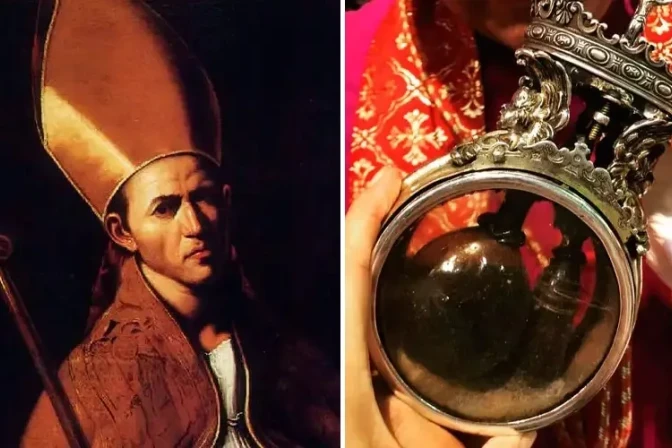
Miracle of the liquefaction of blood of St. Januarius is repeated in Naples, Italy

St. Januarius (left) and the relic of the blood of St. Januarius. / Credit: Chapel of St. Januarius

ACI Prensa Staff, Dec 16, 2025 / 12:58 pm (CNA).

The miracle of the liquefaction of the blood of St. Januarius, patron saint of the Italian city of Naples, occurred again on Tuesday, Dec. 16.

According to the Archdiocese of Naples, the miracle took place after Mass in the Royal Chapel of the Treasure of St. Januarius on the feast of the patronage of St. Januarius.

“At 9:13 a.m. local time, the blood already appeared semi-liquid. At 10:05 a.m., the complete liquefaction was announced,” the archdiocese reported.

“Dec. 16 is the third of three annual celebrations in honor of the martyred saint. This date commemorates the eruption of Mount Vesuvius in 1631, when the Neapolitans requested and obtained the miraculous intervention of St. Januarius to prevent the lava from engulfing the city,” he explained.

The announcement of the miracle was made by Monsignor Vincenzo De Gregorio, abbot of the Chapel of the Treasure of St. Januarius. The phial, once the miracle had occurred, was carried in procession to the chapel so that all those present could see it.

The miracle usually occurs on two other days of the year: every Sept. 19 (the anniversary of St. Januarius’ martyrdom) and the Saturday before the first Sunday of May (in remembrance of the transfer of his remains to Naples).

When the blood does not liquefy, as happened on Dec. 16, 2020, the inhabitants of Naples usually take it as a bad omen. However, in the face of this possibility, the Church encourages the faithful not to lose sight of what is essential.

On Sept. 19, 2024 — despite the miracle having occurred that day — the archbishop of Naples, Cardinal Domenico Battaglia, urged the faithful not to place their hope in physical manifestations but in Jesus, who calls us to care for the most vulnerable.

“I implore you, we should not worry about whether the blood of this relic liquefies or not, but rather we should worry about whether the blood of the dispossessed, the marginalized, the least fortunate, and the innocent is flowing in our streets and in our world,” the cardinal said.

“The blood of Bishop Januarius, let us never forget, always points to the blood of Christ, both the blood of Christ himself and the blood of the poor and the least fortunate in whom Christ lives,” he added.

This story was first published by ACI Prensa, CNA’s Spanish-language news partner. It has been translated and adapted by CNA.

Comments

Popular posts from this blog

SIGNIS Africa renews its leadership

SIGNIS Africa, the Catholic association for media practitioners, has ushered in a new board of directors. For the first time since its inception in 2001, women make up the majority of the board. The election took place on the sidelines of the SIGNIS World Congress happening in Kigali, Rwanda, from 03 August to 08 August 2026. Fr Fidele Mutabazi, a Rwandan priest of the Archdiocese of Kigali, was elected new SIGNIS Africa President. Read all   source https://www.vaticannews.va/en/africa/news/2026-08/signis-africa-renews-its-leadership.html

Manila’s feast of the Black Nazarene draws 9.6 million devotees

The image of the Black Nazarene moves through dense crowds during the 30-hour procession in Manila, Philippines, on Jan. 9, 2026. | Credit: CBCP News Jan 14, 2026 / 11:15 am (CNA). More than 9.6 million Catholics joined the annual feast of the Black Nazarene, one of Asia’s biggest religious events, seeking miracles and hope on Jan. 9 in the Philippines. In a fiery homily at the fiesta Mass, Bishop Rufino Sescon Jr. of the Diocese of Balanga called on politicians implicated in infrastructure corruption to resign, declaring “shame on you” as devotees braved a record-breaking 30-hour procession through Manila’s streets. This year’s Traslacion — the procession of the glass-encased image of Jesus Nazareno — lasted 30 hours, 50 minutes, and 1 second, from Jan. 9–10, the longest procession ever, according to Police Major Hazel Asilo, spokesperson of the National Capital Region Police Office. Last year’s procession lasted 20 hours and 45 minutes and drew about 8.1 million devotees. De...

The "Thin Veil": Understanding the Communion of Saints

Have you ever walked into a quiet, candle-lit cathedral and felt like you were not actually alone? That is not just your imagination or the architecture playing tricks on your mind. It is a brush with one of the most beautiful and often misunderstood dogmas of the Catholic faith: The Communion of Saints. In our modern, "see it to believe it" world, we often feel isolated, as if our spiritual journey is a solo trek. But the Church teaches that the curtain between Heaven and Earth is much thinner than we think. More Than Just "Dead People" When we talk about the Communion of Saints, we are not just talking about the folks on the prayer cards. According to the Catechism of the Catholic Church (CCC 946-962), this "communion" is a three-part family tree that spans across time and space:  1. The Church Militant: That is us, the pilgrims still on earth, battling temptation and striving for holiness.  2. The Church Suffering: The souls in Purgatory who are being p...