
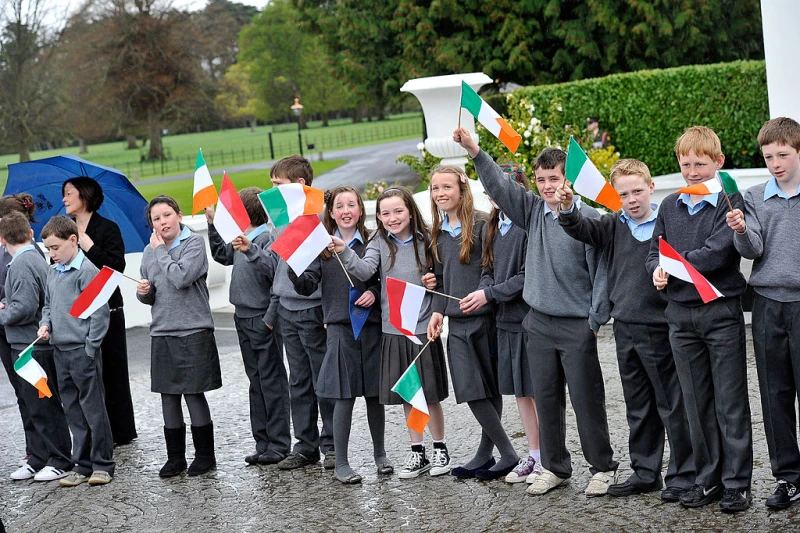
 Schoolchildren attend a ceremonial welcome and tree planting at Aras an Uachtarain, the official residence of the president of Ireland, during a state visit by His Serene Highness Prince Albert II of Monaco and his fiancee, Charlene Wittstock, on April 4, 2011, in Dublin. / Credit: Gareth Cattermole/Getty Images
Dublin, Ireland, Dec 17, 2025 / 06:00 am (CNA).
A U.K. Supreme Court ruling has found that Christian religious education taught in schools in Northern Ireland is unlawful.
In its judgment, the court found that the current approach lacks an “objective, critical, and pluralistic” framework and leans more toward indoctrination than fostering a diverse understanding of beliefs.
Responding to the ruling, which does not apply to Catholic schools, Bishop Alan McGuckian, SJ, of the Down and Connor Diocese firmly challenged the idea that Christianity should be given no priority in all schools, stating that anyone seeking to do so is “cutting off their nose to spite their face.”
The landmark ruling follows a case brought by an unnamed father and his daughter who attended a non-Catholic state-controlled primary school in Belfast. The girl received nondenominational Christian religious education and took part in Christian worship.
The Supreme Court ruling upheld the earlier 2022 high court judgment that “the teaching of religious education under the core syllabus and the arrangements for collective worship in the primary school attended by the child breached her and her father’s rights under European human rights legislation.”
One of the issues referenced in the ruling was the child saying grace before meals at home. This, she told her nonreligious parents, was what they did at school.
The ruling raises critical questions about how religious teachings are delivered in schools and the implications for students’ broader educational experiences.
In the Northern Ireland system, Catholic schools are governed differently from state schools. The Supreme Court judgment clearly states that denominational religious education and collective worship are not prohibited in Catholic-maintained schools.
McGuckian pointed out that the legislative significance of the ruling will in due course have implications for the development of the religious education core syllabus and wider engagement with religious practice and ethos within all of Northern Ireland’s schools.
While noting the Catholic exemption, McGuckian said: “Many people have asked me, while it is explicitly noted in the judgment that this ruling applies to a controlled grant-aided primary school and does not apply to Catholic schools, what difference is this Supreme Court ruling going to make to the provision of religious education across NI schools more widely? Is religion being driven out of schools? More specifically, some are asking, ‘Is Christianity being driven out of schools?’”
McGuckian noted: “I want to challenge the principle that people of a secular mindset assert, namely that Christianity should be given no priority in all schools. That principle is simply ungrounded, unreasonable, and illogical.”
“Christianity and the Judeo-Christian worldview provides the value-based foundation for all that is good in Western society and is deeply embedded within human rights legislation. The idea of the rights of the individual to be free from coercion, all the freedoms contained in the various charters of human rights, are based on and stem from the biblical teaching that every single person is created in the image and likeness of God.”
He continued: “Enlightenment thinkers of a more secular viewpoint have built on that ‘fundamentum,’ and, in many ways, they have served us well, but they grounded and built their insights on underlying Christian values that protect the dignity of every human person.”
“Those who seek to have Christianity sidelined in our shared society are cutting off their noses to spite their face,” he said.
McGuckian added that world religions should also be respected, and they also have a contribution to make in an increasingly diverse multicultural and multi-faith society. He continued: “However, it should be recognized that Christianity, centrally and uniquely, has provided the framework of values that underpin Western society.”
“In schools across the Western world, Christianity should, indeed, be given priority in our educational systems and everybody, including those of other faiths and none, should recognize and welcome this because of its foundational importance.”
While the ruling does not apply to worship and prayer in Catholic schools, it will impact and influence the religious education curriculum taught in schools, which is determined by school education authorities. The current curriculum has been in place since 2007, and its content was determined by the four main churches in Northern Ireland, which include Catholicism.
Speaking to the BBC, the Catholic bishop of Derry, Donal McKeown, said he is positive about the need for a new religious education core curriculum and is quite open to where this goes.
“I’m looking forward to the next stage of the journey, I don’t see it as a negative thing,” he said. “There are many points to be clarified — this is an opportunity for all of us to be involved in renewing the [religious education] curriculum to enable us to create a healthy, forward-looking society.”
Comments
Post a Comment